By Vasile Teterea, Owner and CEO, Firm Remodeling LLC | LIC #: FIRMRRL783PU | Serving Issaquah, Sammamish, Newcastle, Renton, Kent, Covington, Hobart, and Maple Valley, WA
We put in the same shower enclosures all over Issaquah. Same glass, same hardware, same guy installing it. Come back two years later and half of them look like we left yesterday, while the other half have gone milky across the bottom foot and won’t come clean.
For a long time I chalked that up to cleaning habits. Some of it is. But the cloudy ones keep turning up in the same neighborhoods, and once you know why, you can’t unsee it.
Issaquah runs on two different water supplies
Most of the city drinks groundwater. The City of Issaquah’s own drinking water sources page says four wells feed a big share of the system, two in the northeast part of town and two in the northwest, sunk anywhere from 100 to 400 feet down.
The Issaquah Highlands and Talus are different. So are Montreux and Lakemont. Those get water from the Cascade Water Alliance, which is regional surface water, and it behaves nothing like water that’s spent years working its way through soil and rock.
Groundwater picks up calcium and magnesium on the trip. Cascade water mostly doesn’t, which is where greater Seattle gets its reputation for very soft water. So a family in the Highlands and a family in Olde Town can buy the identical shower glass on the same Saturday afternoon and have completely different luck with it.
If you want your actual hardness number, it’s in the Consumer Confidence Report the city mails out to every water customer once a year. I’m not going to quote you a figure I can’t stand behind. And the number matters less than what your current glass looks like, which is the part you can check yourself.
Go look at the shower door you already have
Stand in your bathroom. Look at the glass at eye level, then look at the bottom eighteen inches.
If the lower section reads hazy or faintly white even right after you’ve cleaned it, and there’s a slight roughness when you run a finger down it, that’s mineral that has already bonded to the surface. Soap scum comes off. This doesn’t.
Here’s the part people have a hard time with. Glass isn’t perfectly smooth at a microscopic level. When hard water dries on it, the minerals settle into that texture and slowly etch it, and past a certain point no cleaner reverses it, because the damage is in the glass instead of on it. You can polish some of it back out with cerium oxide if you’re patient and a little obsessive about it. Most people just replace the panel.
So prevention is the whole game, and prevention gets decided during the remodel, not after.
What actually matters, roughly in order
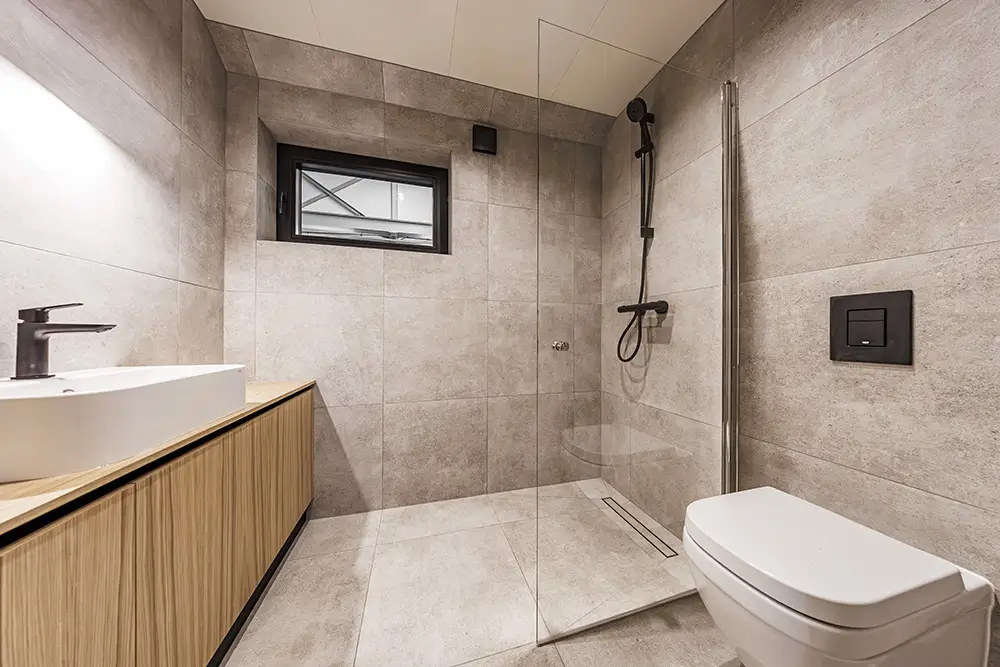
Less glass beats treated glass. If you’re on well water and you want a shower that still looks right in eight years, the strongest move is a single fixed panel instead of a full enclosure with a door, a header, and a return panel. Fewer square feet of glass, fewer seals, fewer corners where water pools. It also looks better in most Issaquah bathrooms. We build a lot of these into curbless walk-in showers, where the open panel is already the natural design.
That reads like I’m talking you out of something, and I am. A full enclosure is a bigger line item for us and I still think most people should buy less glass.
Factory coating earns its money on hard water and barely registers on soft. It’s a protective layer fired onto the glass at the plant, filling in that surface texture so deposits sit on top instead of biting in. It works. It also wears off, usually somewhere between year two and year five depending on how hard the household scrubs. On groundwater it buys you real time. On Cascade water up in the Highlands, skip it and I won’t argue with you. The aftermarket sprays we can apply on site are a weaker version of the same idea, and they need redoing a few times a year.
A squeegee beats both of them. Thirty seconds after the last shower of the day, every day. Nothing else on this page comes close. If nobody in the house is going to do it, plan the bathroom around that instead of pretending otherwise.
Tile, grout, and fixture finishes on hard water
Mineral film shows up worst on dark, glossy, flat surfaces, because that’s where a white haze has the most contrast and the least texture to disappear into. High gloss charcoal wall tile is a beautiful pick and a rough one to live with in a well water house.
Mid-tone tile in satin or honed hides spotting much better and still wipes down easily. Fully matte and heavily textured tile hides the film but grabs onto it, so you’re trading appearance for scrubbing. Our post on choosing tile for a bathroom remodel covers the broader selection logic, and hardness is one more thing to feed into it.
For grout, use a good epoxy or a modern cement grout with a proper sealer, and stay a shade or two off pure white. Pure white grout on hard water goes blotchy cream in patches and reads as dirty even when it’s clean.
Fixture finish is the one that catches people off guard. Polished chrome hides water spotting better than almost anything. Not glamorous, but true. Brushed nickel sits in the middle. Matte black shows every mineral spot as a light gray fleck, and it’s far and away the finish we hear the most complaints about from clients on groundwater. If you love matte black you can absolutely have it. Just know you’re signing up to wipe it down.
Two problems people mix up
City water hardness and private well staining aren’t the same thing, and they don’t have the same fix.
Calcium and magnesium leave a white or gray film. That’s the hardness issue, and it touches everyone on Issaquah’s groundwater wells to some degree.
Iron and manganese leave orange or brown streaks, usually running down from the fixture or pooling in the tub. That’s a private well problem, and it shows up in the unincorporated pockets out toward the mountains far more than inside the city system. If your stains are orange, a water softener won’t fix it. You need an iron filter, and no tile or fixture selection is going to save you.
Seeing both? Get the water tested before you order anything.
The cheap thing to do while the walls are open
If a softener is anywhere on your list, put the loop in during the remodel.
Roughing in the plumbing for one while the wall is already open is a small addition to a job that’s happening anyway. Doing it two years later means cutting open finished walls, which is the expensive version of the same work. Same math as heated tile floors, where the mat itself costs a fraction of what it costs to go back and add later.
Ventilation belongs in this conversation too. A fan that can’t clear the room leaves mineral-heavy droplets sitting on the glass and tile to dry in place, every single day. An undersized fan is a hard water problem as much as a mold problem, and undersized fans are the norm in bathrooms built in the 2000s.
What I’d do this week
Check the bottom of your current shower glass and see whether the haze actually wipes off. Find out whether your address is on the city wells or on Cascade water, remembering that the Highlands, Talus, Montreux, and Lakemont are on Cascade. If you’re on a private well and seeing orange, get a water test.
Then pick the enclosure to match the water you actually have, instead of the one you saved a photo of.
Our post on keeping new bathroom tile looking right covers the routine once the job is done. You can see how these turn out in our recent projects, and the full scope of our bathroom remodeling in Issaquah is on the service page. If you’d rather we look at your water situation before you commit to glass and finishes, get in touch and we’ll come walk it with you.
