By Vasile Teterea, Owner and CEO at Firm Remodeling LLC — WA License #FIRMRRL783PU
Almost every kitchen remodel we quote in Kent gets to the same fork in the road. The homeowner wants more counter space, a place for the kids to sit, and somewhere to put the stuff that’s currently piled on the dining table. The question is whether that comes as an island sitting free in the middle of the room, or a peninsula attached to a wall or run of cabinets at one end.
People treat this like a style choice, and it really isn’t. Which one works in your house comes down to how wide your room is, where the load-bearing walls sit, and how much you’re willing to spend moving water and gas to the middle of the room. I’ve put both into Kent kitchens for years, so here’s how I walk clients through it.
The clearance rule that decides most of it
Before we talk about which one looks better, measure your room. An island needs walkways around it, and those walkways have minimum widths if the kitchen is going to be usable.
We aim for at least 42 inches of clear floor between an island and the cabinets or appliances around it. If two people cook in your house at the same time, or you’ve got an appliance door that swings into that gap, push it to 48. Below 36 inches it stops being a kitchen and starts being an obstacle course, and you’ll feel it every single day.
Run the math on your own room. Take the width of the kitchen, subtract two walkways, and whatever’s left is the widest island you can fit. A 12-foot-wide kitchen minus two 42-inch walkways leaves you about 5 feet for the island. That’s enough for a decent prep surface but tight for seating plus a sink. Anything narrower than about 13 feet and an island usually doesn’t pencil out, which is the moment a peninsula starts making sense.
A peninsula only needs clearance on three sides instead of four. It connects to your existing cabinet run at one end, so it eats less of your floor. In the narrower Kent kitchens we see a lot, especially the galley layouts in the older Lake Meridian and East Hill homes, the peninsula is often the only thing that fits.
Where each one wins
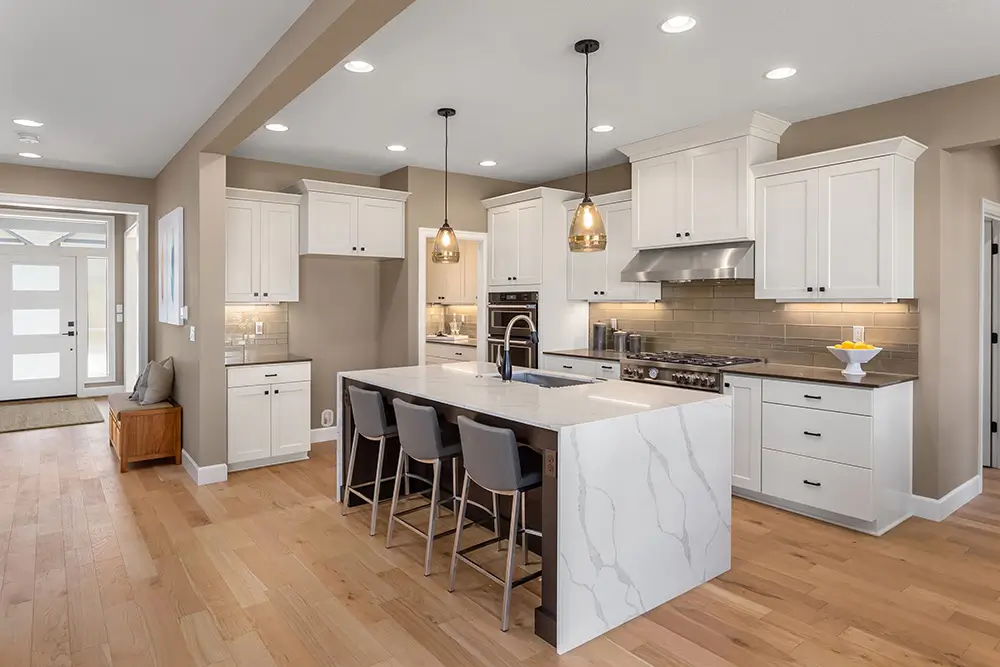
An island gives you a true work zone you can walk all the way around. You can put the cooktop or the prep sink in it and face into the room while you work, which is what most people are after when they open up a kitchen. It also reads as the centerpiece of the room. If you’ve taken a wall down and opened the kitchen to the family room, an island is usually what you picture.
A peninsula gives you most of the same counter and seating for less money and less square footage. Because it ties into a wall, getting plumbing or power out to it is often cheaper, sometimes a lot cheaper. It also creates a natural divider between the kitchen and the next room without closing anything off, which works well when you want a little separation but not a full wall.
There’s a comfort difference at the seating, too. Island stools usually tuck under one long side, and people sit shoulder to shoulder facing the cook. A peninsula can seat people around a corner, so they can actually talk to each other. Small thing, but families notice it.
The plumbing and gas question nobody asks early enough
This is where budgets move, so I bring it up on the first walkthrough.
If you want a sink or a dishwasher in your island, the water supply and the drain have to run under the slab to reach the middle of the room. In a house with a crawl space, that’s not too bad. On a slab foundation, or a finished basement ceiling you don’t want to cut into, it gets expensive and occasionally it’s the thing that kills the island idea entirely. Same story with running a gas line out to an island cooktop.
A peninsula sits against existing cabinetry, so the plumbing and gas usually have a much shorter, easier path. When a client is set on a sink in the new feature but the island plumbing run is brutal, switching to a peninsula can save thousands and still get them the sink.
Then there’s the wall itself. Going open-concept to make room for an island often means removing a wall, and in a lot of Kent homes that wall is holding up the roof. We covered the real cost of that in our Kent kitchen remodel cost post — a load-bearing wall removal with the engineer and the LVL beam ran about $9,000 on top of a recent Meridian-neighborhood project. A quick way to guess: walls running perpendicular to your ceiling joists are usually load-bearing, walls running parallel usually aren’t. Don’t swing a sledgehammer based on a guess, though. Get an engineer to confirm.
What we tell Kent homeowners to do
Here’s the short version of the conversation I have at the kitchen table.
If your kitchen is 13 feet wide or more and you’ve either got an open layout already or you’re planning to open one up, an island is probably worth it. Put the seating on one side and keep the prep zone clear. Decide early whether you want a sink in it, because that decision drives the plumbing budget more than almost anything else.
If your kitchen is narrower than 13 feet, or it’s a galley, or the foundation makes running plumbing to the center of the room a headache, a peninsula will almost always serve you better. You give up the walk-around, but you keep the counter, keep the seating, and keep more money in the project for cabinets and counters that last.
On the cabinets that go into either one: spend there. The island or peninsula is the piece your family touches most, and it’s the hardest thing to swap out later without disturbing the counter and the plumbing. We ranked the brands we actually trust at the five-year mark in our cabinet brands post, and the same logic applies whether the box ends up in an island or against a wall.
One last thing, and it has nothing to do with islands. Before you hire anyone for a job this size, check their license. Run the registration number through the Washington State Department of Labor & Industries contractor verification tool. Ours is FIRMRRL783PU. If a contractor isn’t in there, active and current, don’t write the check.
If you want a real answer for your specific room — whether an island fits, what the plumbing run looks like, what it’ll cost — we’ll come measure and tell you straight. Most of our work is in Kent and the surrounding South King County cities; you can see service-area details and project examples on our home remodeling Kent page, or call (206) 773-8264 for a free in-home estimate.
